
07 July 2026 | Tuesday | Interaction
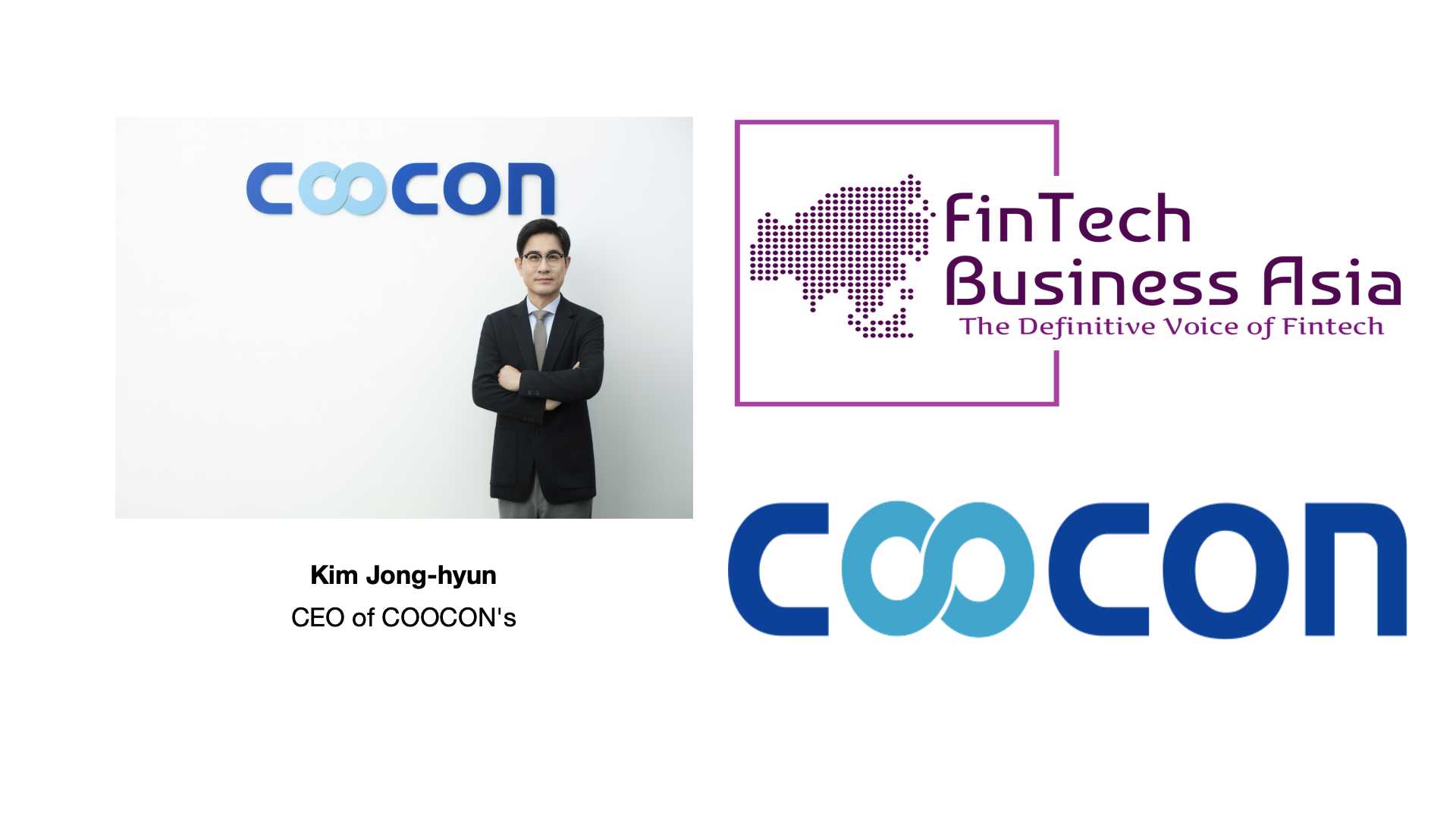
As artificial intelligence evolves from an advisory tool into an autonomous economic participant, the financial services industry is preparing for a future where AI agents can independently access data, make decisions, and execute payments. Following COOCON's membership in the Agentic AI Foundation (AAIF), FinTech Business Asia spoke with CEO Kim Jong-hyun about why Asia is uniquely positioned to lead this transformation, how the company is leveraging Model Context Protocol (MCP) to create AI-ready financial infrastructure, and why interoperability, regulatory compliance, and trust will determine the success of agentic commerce. Kim also shares COOCON's strategy for expanding AI-powered data services, cross-border payments, and future stablecoin settlement across the region.
Q: COOCON has joined the Agentic AI Foundation at a time when AI agents are beginning to move beyond recommendations and toward executing transactions. How do you envision AI agents transforming the payments landscape over the next three to five years, particularly in Asia's highly digitalized markets?
A: Asia is the natural proving ground for this shift. Consumers here already live inside QR codes, super-apps and instant transfers, so the leap from an agent that recommends to an agent that pays is smaller than in cash-heavy markets. Over the next three to five years, we expect agentic payments to move through the same corridors that already carry the region's real-time volume: QR acceptance networks, ATM/cash-out rails, and cross-border wallets, rather than requiring entirely new infrastructure.
For COOCON, that means our existing footprint of 2 million QR merchants, 100,000 franchise touchpoints and 40,000 ATMs is not legacy infrastructure to be replaced, but the substrate an AI agent will actually transact through. The winners in this transition will be infrastructure providers that can hand an agent a single, standardized way to both read financial data and execute a payment, which is precisely the gap we are building toward with our data (MCP) and payment stack.
Q: One of the key areas of participation for COOCON within AAIF is AI agent payments. What technical, regulatory, and trust challenges must the industry overcome before autonomous AI agents can securely initiate and complete financial transactions at scale?
A: Three layers need to mature together. Technically, the industry still has multiple competing protocols for how an agent discovers data, negotiates and pays, which is exactly why standardization bodies like AAIF matter and why we prioritized joining as an infrastructure member rather than watching from the sidelines.
Regulatorily, existing KYC/AML frameworks were built around a human initiating a transaction; they were not built for a delegated agent acting on a human's behalf, at machine speed, across borders. That raises real questions of liability, consent scope and traceability that regulators across the region are only beginning to address.
Trust is the layer that ties the other two together. An agent-initiated payment needs the same auditability, spending limits and dispute mechanisms that a card network provides today, arguably more, given the speed at which agents can act. This is why COOCON has been an early advocate for 'Know Your Agent' (KYA) concepts within the AAIF working groups: identity and accountability for the agent itself, not just the human principal, will be a precondition for scale.
Q. COOCON has highlighted the Model Context Protocol (MCP) as a strategic focus. How do you see MCP changing the way financial institutions, fintechs, and AI systems access and utilize data, and what new business opportunities could emerge from this shift?
A: MCP replaces a fragmented world, in which every institution wires up its own bespoke integration to every data source, with a single, open interface that any AI agent can call. We describe our role in that world as the 'USB-C of the AI ecosystem': one standardized socket, many devices plugging into it.
Commercially, this changes the economics of data distribution in two ways simultaneously. First, an agent completing one task typically calls multiple APIs in parallel rather than a single sequential call a human developer would write, which structurally lifts call volumes. Second, MCP-native data carries a legitimate premium over legacy REST APIs because it comes packaged with the context, security and standardization an agent needs to act on it safely, so unit pricing rises alongside volume rather than the two offsetting each other.
We are acting on this directly: COOCON is launching a dedicated AI-ready data zone on our COOCON.NET platform this July, starting with roughly 30 MCP-formatted products and scaling toward full portfolio coverage by 2027. The opportunity this opens is not just for us; it is for every financial institution and fintech in the region that would rather consume standardized, agent-ready data than rebuild integrations for every new AI use case.
Q: The company has identified global payments, stablecoins, and AI-powered data services as three major growth pillars. How do these areas intersect, and which do you believe will have the greatest commercial impact in the near term?
A: The three pillars are stages of a single workflow rather than separate businesses: an agent first queries data (MCP) to understand a situation, reasons over it, then executes a payment (QR, ATM cash-out, or eventually stablecoin settlement) to act on that decision. Very few companies in our market hold both the data layer and the payment rails needed to support that full loop end-to-end, and we believe COOCON is the only one in Korea that does.
On sequencing, the AI-based data business is the pillar we expect to show commercial impact first, because MCP monetization has a direct and near-term line to our income statement through the volume-and-price dynamic I described earlier, and it is already scheduled to go live this year. Global payments is scaling steadily and predictably, supported by the recovery in inbound tourism and a growing web of cross-border QR linkages — including QRIS with Indonesia, WeChat Pay and UnionPay for Chinese travelers, Alipay+ across Southeast Asia, and our partnership with Liquid Group spanning Singapore and beyond. Stablecoin settlement is the pillar with the largest option value but the longest fuse, since it depends on legislative clarity in Korea, so we are building the technical readiness now, through our Solana Foundation collaboration and proof-of-concept work, so that we can move immediately once the regulatory path is set, rather than starting from zero.
Q: AAIF includes major technology and financial industry participants such as OpenAI, Google, Microsoft, Stripe, and others. What specific opportunities does this ecosystem create for COOCON, and are there particular collaborations or standards initiatives that you are most excited about?
A: AAIF gives us something a single bilateral partnership cannot: a seat at the table where the actual rules of agentic commerce are being written, alongside the organizations building the agents themselves. For a company our size, that is a far more efficient way to secure interoperability than negotiating integrations one counterparty at a time.
Two threads inside AAIF matter most to us. The first is the Know Your Agent (KYA) and agent-identity work, because whoever helps define how an agent proves who it is acting for will shape how payment and data permissions are granted industry-wide, and we want COOCON's dual data-and-payment perspective represented in that conversation. The second is the broader convergence of agent-commerce protocols sitting alongside MCP: the standards that will let an agent move from 'reading data' to 'completing a transaction' without a custom integration at every step.
Strategically, this network also travels with us as we build out our Singapore hub for Southeast Asia. The same standards and counterparties we are engaging through AAIF are the ones we expect to matter most as we extend our QR, ATM and cross-border rails deeper into the region, so membership is as much a regional expansion tool for us as it is a technology forum.
Q: As payment networks prepare for a future where AI agents may act on behalf of consumers and businesses, what role do you believe payment infrastructure providers like COOCON will play in ensuring interoperability, compliance, and security across global markets?
A: We see three distinct but related roles for infrastructure providers in this transition, and none of them can be outsourced to the agent developers themselves. The first is interoperability: an AI agent built by one company should not need a custom integration for every bank, wallet or merchant network it touches in every market it operates in. That is a job for neutral infrastructure, the same role COOCON has played for two decades in connecting over 2,500 institutions through a single API layer, now extended to agents rather than only human developers.
The second is compliance translation. Regulation will keep evolving faster than any single global standard, and it will keep varying market by market, since Korea's approach to agent-initiated transactions will not be identical to Singapore's or Indonesia's. Infrastructure providers sit at the point where a transaction actually crosses a border or touches a regulated rail, which makes us the natural layer to encode local AML/CFT, KYC and, increasingly, KYA requirements into the transaction itself, so that an agent's developer does not need to become a compliance expert in every jurisdiction it serves.
The third is security and accountability at the point of execution. However sophisticated an agent's reasoning becomes, the moment it moves value, there needs to be a rail that can authenticate the transaction, enforce spending limits and consent scope, and produce an auditable trail if something goes wrong. That is precisely where payment infrastructure, spanning QR acceptance, ATM cash-out and cross-border settlement, earns its role: not as a passive pipe, but as the checkpoint that makes agentic commerce trustworthy enough for banks, merchants and regulators to actually adopt it.
This is also why COOCON joined AAIF as an infrastructure member rather than waiting for standards to be finalized elsewhere. Providers that combine data access and payment execution under one roof, as we do, are in the best position to make interoperability, compliance and security work together as a single, coherent layer, rather than three separate problems bolted on after the fact.



Fintech Business Asia, a business of FinTech Business Review
© 2026 FinTech Business Review. All Rights Reserved.