
03 August 2026 | Monday | Interaction
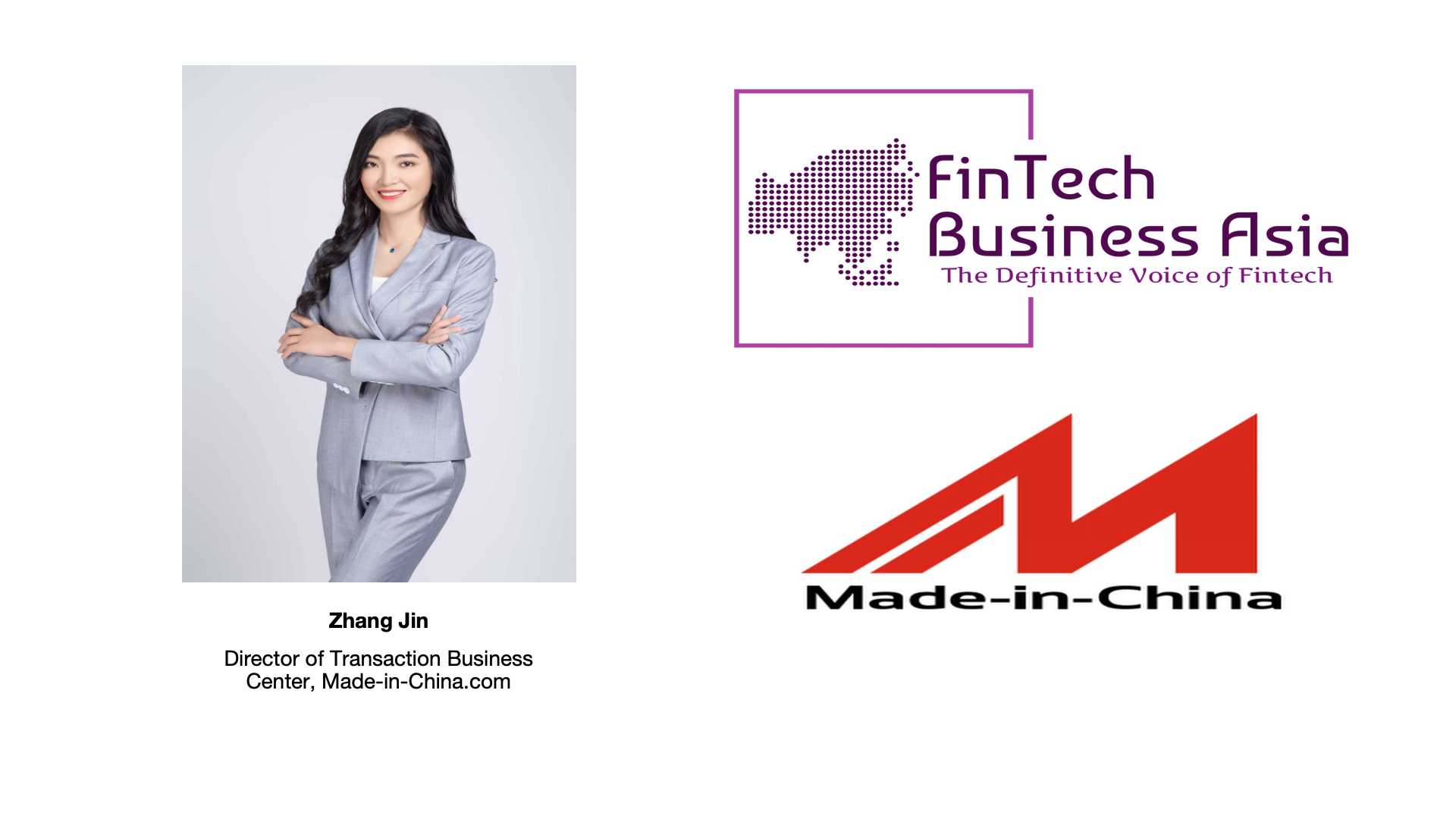
As global supply chains become more digital and businesses diversify sourcing across Asia, cross-border payments, transaction security and procurement efficiency have become critical priorities. In this exclusive conversation with Fintech Business Asia, Zhang Jin, Director of Transaction Business Center at Made-in-China.com, explains how the company's fintech ecosystem—from AI-driven sourcing and escrow-based payments to supplier verification and embedded finance—is transforming international B2B commerce while building greater trust, transparency and efficiency for buyers and suppliers worldwide.
Q: Made-in-China.com has positioned its Secured Trading Service as a solution for both small trial orders and multi-million-dollar procurement deals. How does the platform's payment and escrow infrastructure help buyers reduce financial and operational risks in cross-border transactions?
A: The risks involved in cross-border procurement extend well beyond the payment stage. They can arise throughout the entire process, from supplier verification and order negotiation to production, inspection, shipping, delivery and after-sales service. For this reason, the Secured Trading Service offered by Made-in-China.com is not simply an additional payment option. Its purpose is to connect the flow of funds, order information, logistics data and service support within a unified transaction framework.
In terms of fund security, once a buyer makes a payment through the Secured Trading Service, the funds are first placed within a platform-managed escrow arrangement rather than being transferred directly to the supplier. Depending on the size of the order, the production cycle and the delivery schedule, buyers and suppliers can agree on payment structures such as deposits, milestone payments and final balances, together with the corresponding release conditions. The platform releases the relevant funds to the supplier only after the buyer confirms satisfactory receipt, logistics records show that the goods have been successfully delivered, or pre-agreed milestones—such as completion of production, inspection or shipment—have been met.
If there is a quality discrepancy, a delivery delay, non-receipt of goods or another fulfilment dispute, the platform can step in before the funds are released. It can assist both parties by reviewing the order records, logistics information and supporting evidence they provide. Linking the release of funds to actual fulfilment progress helps limit the buyer’s financial exposure while the goods remain undelivered or the order is still incomplete.
The same mechanism also provides suppliers with greater payment certainty. Payments submitted by buyers are subject to the platform’s risk-control assessment. For higher-risk transactions, the platform may restrict the available payment methods or block the payment altogether. This helps reduce the risks associated with invalid orders, malicious chargebacks or uncertainty over a buyer’s ability to pay. Clearly defined milestone-payment terms also allow suppliers to plan raw-material purchases, production schedules and logistics arrangements more effectively, while receiving the relevant funds promptly once the agreed obligations have been fulfilled.
For buyers and suppliers working together for the first time, this two-way protection reduces uncertainty on both sides, improves order execution and creates a stronger foundation for long-term cooperation.
Made-in-China.com also provides different payment arrangements for different procurement scenarios. For samples and smaller trial orders, buyers can use credit cards, debit cards, Google Pay, Apple Pay and selected local payment methods. These options allow them to assess product quality and a supplier’s fulfilment capabilities without making a large initial commitment. For higher-value bulk purchases, buyers can use bank transfers and other methods that are more closely aligned with corporate procurement procedures.
According to the platform’s published guidance, bank-transfer orders can be created in US dollars, euros and Chinese renminbi, with no stated upper limit on the order value. This makes the service suitable for the large-volume procurement requirements of major enterprises. The platform also supports deposit payments, enabling buyers and suppliers to structure payment schedules around production and delivery milestones.
Operational risks must also be managed. Through a centralized order dashboard, buyers can review and confirm quotations, track order amendments, monitor payment status, follow logistics progress and receive alerts when exceptions occur. This reduces the information gaps that often result from relying on fragmented email exchanges, offline remittance records and manual follow-ups. Before making payment, buyers can also review available shipping methods, estimated costs and expected delivery times, giving them greater predictability when planning budgets and delivery schedules.
This framework is already capable of supporting both frequent small-scale trial orders and enterprise-level procurement. For example, a Japanese retail group completed 18 online transactions through the platform in 2025, with an annual procurement value of more than US$20 million. For large buyers, the real value lies not simply in being able to make a payment, but in ensuring that every payment is tied to a specific order, defined fulfilment milestones and a traceable transaction record.
Q: Cross-border payments remain a major challenge for global B2B trade. What fintech innovations has Made-in-China.com introduced to simplify payment processing, improve transaction transparency, and shorten settlement times for international buyers and suppliers?
A: We see four recurring pain points in cross-border payments: limited payment-method compatibility, insufficient transparency, friction in compliance reviews, and a disconnect between payment and order fulfilment. For Made-in-China.com, the focus is not on pursuing any single financial technology for its own sake. It is on bringing multiple payment channels, transaction risk controls and fulfilment data together within the same sourcing and procurement journey.
The first area is the embedded payment experience. Buyers can select a payment method without leaving the order process, based on the value of the order, their location and their internal finance requirements. Available options include bank transfers, card payments, PayPal, Google Pay, Apple Pay and selected local payment methods. The platform has integrated localized payment options such as PIX, SPEI, OXXO, PSE and OZOW, while also supporting enterprise-oriented methods such as T/T for bulk orders. This payment-orchestration model reduces the need for buyers to work with separate payment providers, reconcile payments manually with individual orders, or repeatedly submit the same transaction information.
The second area is the connection between payment and order data. In a traditional offline remittance process, payment records, contracts, product specifications and logistics information are often spread across different systems. When a transaction is completed through the platform, the payment status, order value, supplier quotation, address details, product information and shipping progress can all be viewed within the same order record. Buyers can see whether the funds are awaiting payment, under review, being held or ready for release. In many B2B transactions, that level of visibility is more important than payment speed alone.
The third area is automated risk monitoring. The platform uses risk models and anti-fraud systems to monitor payment activity, respond to abnormal or suspicious transactions, and request additional identity or company documentation where necessary. Bank transfers may also be subject to account verification and anti-money-laundering checks. The purpose is not to introduce unnecessary barriers, but to identify issues such as account mismatches, identity anomalies or potential fraud before funds are transferred.
The fourth area is greater predictability in processing times. The platform’s published payment guidance provides indicative processing periods for different methods. Some card payments, PayPal transactions and local payment methods can be processed relatively quickly, while bank transfers may require more time. Our point is not that every cross-border payment can settle instantly. What matters is that both buyers and suppliers understand the expected costs, processing timeline and release conditions before the payment is made.
That is how we think about fintech: not simply as a way to move money across borders faster, but as a way to make the purpose of the payment, the status of the funds, the compliance process and the fulfilment outcome clearer. Speed must improve alongside security, transparency and traceability.
Q: As businesses diversify their sourcing strategies amid shifting global trade dynamics, what trends are you seeing in buyer demand across Asia, and how is your platform adapting its financial and trade services to support this evolution?
A: The first trend is a clear divergence across Asian markets. For Made-in-China.com, Japan and South Korea continue to account for the largest share of activity, while Thailand, the Philippines and Malaysia are emerging as key growth markets in Southeast Asia. South Asia and Central Asia remain smaller in overall scale, but India accounts for around 80% of the South Asian market, highlighting the region’s longer-term potential.
The second trend is the growing diversity of order structures. Large enterprises typically require stable bulk procurement, complete compliance documentation and predictable delivery schedules. SMEs, e-commerce sellers and emerging brands, on the other hand, are more inclined to place smaller trial orders so that they can test market demand quickly and limit inventory risk. A platform therefore needs to support both scale and speed, rather than being designed around a single type of transaction.
The third trend is rising demand for localized, digital-first services. Buyers increasingly expect to use familiar payment methods, receive clear information on fees and exchange rates, and monitor orders and logistics in real time through an online dashboard, rather than relying on repeated email exchanges. The rapid adoption of digital payments across Asia is also raising business expectations for greater convenience and transparency in cross-border transactions.
In response to these trends, we are focusing on three areas:
The first is the regional adaptation of financial services. For high-value industrial orders, we are improving fund-withdrawal processes and developing supporting supply chain finance solutions to ease working-capital pressure for both buyers and suppliers.
The second is a more localized and market-specific trade service model. Through our “New Navigation Initiative,” we are conducting deeper country-level operations in priority markets such as Southeast Asia and Central Asia. This includes multilingual websites and dedicated market showcases, as well as targeted buyer-supplier matching through local exhibitions and BizConnect events. We are also expanding access to inspection, logistics and compliance-consulting services in local markets, allowing Asian buyers to receive support closer to where they operate.
The third is the use of intelligent tools to improve efficiency. SourcingAI can interpret a buyer’s procurement requirements and identify suitable Chinese suppliers automatically. It also provides real-time multilingual translation and support for business communication, helping reduce the language and cultural barriers involved in cross-border sourcing and enabling buyers to make decisions more efficiently.
Q: Trust is often the biggest barrier for companies placing large international orders with new suppliers. Beyond secure payments, what verification, compliance, and dispute-resolution mechanisms does Made-in-China.com provide to give buyers greater confidence?
A: Secure payment addresses the question of whether the buyer’s money is protected, but a large international buyer also needs answers to several other questions. Does the supplier genuinely exist? Does it have the required production capacity? Can the goods meet the agreed specifications? And is there a workable process if the transaction does not proceed as expected?
The first layer is supplier verification. Made-in-China.com introduced its Audited Supplier programme in 2007 and works with independent organizations including SGS, Bureau Veritas, TÜV Rheinland and CTI. The process can include document reviews and on-site verification of facilities such as raw-material warehouses, production areas, testing laboratories and finished-goods warehouses. Audit reports are made available to buyers online and may cover company information, export capability, manufacturing capacity, service capability, quality control, research and development, financial capability and sustainability.
The second layer is compliance and transaction-risk control. Depending on the transaction, checks may cover the business entity, qualifications, bank-account information and payment behaviour. The platform’s risk model and anti-fraud system can identify suspicious activity, while account inconsistencies or anti-money-laundering screening may lead to a transaction being paused for additional verification. These checks may add a limited amount of friction at the beginning, but they can reduce the much greater risk of funds being sent to an incorrect or abnormal account.
The third layer is independent inspection. Buyers may arrange third-party inspection before shipment or before the relevant payment milestone is completed. The inspection can assess quantity, appearance, quality and other agreed requirements.
The fourth layer is an evidence-based refund and dispute process. Buyers can report issues such as non-delivery, quality or quantity discrepancies, suspected counterfeit goods or a failure to fulfil agreed after-sales obligations. The platform may review the order record, communications, logistics data, photographs, videos and inspection reports when assisting the parties. Eligible orders can proceed through return, refund or dispute-mediation workflows, but outcomes are determined by the evidence and the applicable platform rules rather than by an unconditional reimbursement promise.
Our objective is to create several layers of trust: supplier verification before an order, optional inspection before shipment, payment protection and logistics visibility during the transaction, and a defined dispute process afterwards. In large B2B procurement, trust is not created by a badge alone. It is created through processes that can be verified, documented and enforced.
Q: With embedded finance becoming an important part of digital commerce, do you see opportunities to expand services such as trade financing, supply chain finance, or embedded lending to further support SMEs engaged in cross-border sourcing?
A: We see a clear long-term opportunity in this area. A B2B platform can have a useful role in embedded finance because, subject to appropriate authorization and data protections, it can connect financing decisions with genuine commercial activity. The platform may have visibility into inquiries, purchase orders, payment milestones, logistics events and fulfilment records. Compared with relying only on static documents submitted by an applicant, verified transaction data can help a financial institution understand the context and current status of an underlying trade.
Potential industry models could include purchase-order-based trade finance, earlier payment for suppliers, structured payment terms for buyers, receivables finance, and solutions linked to insurance, guarantees or foreign-exchange management. For an SME, the most valuable feature is not necessarily the largest possible credit line. It may be financing that is aligned with the order cycle, transparent in cost and simpler to apply for.
With this in mind, we are actively exploring a range of possibilities. For example, buyers with strong credit profiles could, in the future, be offered embedded “buy now, pay later” or instalment-financing options directly at the order-payment stage.
Our aim is to make financial services a seamless part of the trade process, available wherever they are genuinely needed. By reducing working-capital barriers, we hope to give SMEs greater flexibility and confidence when sourcing globally.
Q: Looking ahead, how do you envision AI, digital payments, and other fintech technologies transforming global B2B sourcing over the next five years, and what role will Made-in-China.com play in shaping that future?
A: Over the next five years, we expect three significant changes in global B2B sourcing.
The first is that artificial intelligence will evolve from helping buyers search for products to assisting them across a much broader procurement workflow. Made-in-China.com has already introduced SourcingAI to help global buyers find and evaluate Chinese suppliers more efficiently. Our objective is not to have AI make every procurement decision on behalf of the buyer. It is to convert fragmented information into clearer decision support, allowing procurement professionals to devote more time to commercial judgement, negotiation and supplier-relationship management.
The second change will be the continuous embedding of compliance and risk controls into the transaction process. Instead of waiting until a payment fails or a dispute occurs, future platforms will increasingly assess risk during supplier matching, quotation, ordering, payment and shipment. AI can assist with the review of company information, account details, product requirements and transaction behaviour, but consequential decisions will still require defined rules and appropriate human oversight.
In this new industry landscape, Made-in-China.com will take on three core roles:
First, builder of a digital foreign trade operating system. We will continue to put AI technology at the core, translating three decades of accumulated trade experience and data into intelligent capabilities, and building a full-link foreign trade operating system covering sourcing, negotiation, transactions, logistics, settlement, and after-sales. We aim to help buyers and sellers standardize and simplify complex cross-border trade.
Second, builder of trust infrastructure for global trade. We will continue to strengthen qualification verification, risk control, and dispute resolution capabilities with digital technology, positioning the platform as a trust hub for cross-border trade, so that unfamiliar enterprises can confidently conduct large-scale cooperation.
Third, enabler of globalization for micro, small and medium-sized enterprises. We will democratize cutting-edge capabilities such as AI, digital payments, and supply chain finance, so that vast numbers of SME buyers and suppliers can access enterprise-grade cross-border trade services without heavy investment, truly lowering the barrier to participation in global trade.





Fintech Business Asia, a business of FinTech Business Review
© 2026 FinTech Business Review. All Rights Reserved.