

14 July 2026 | Tuesday | Interaction
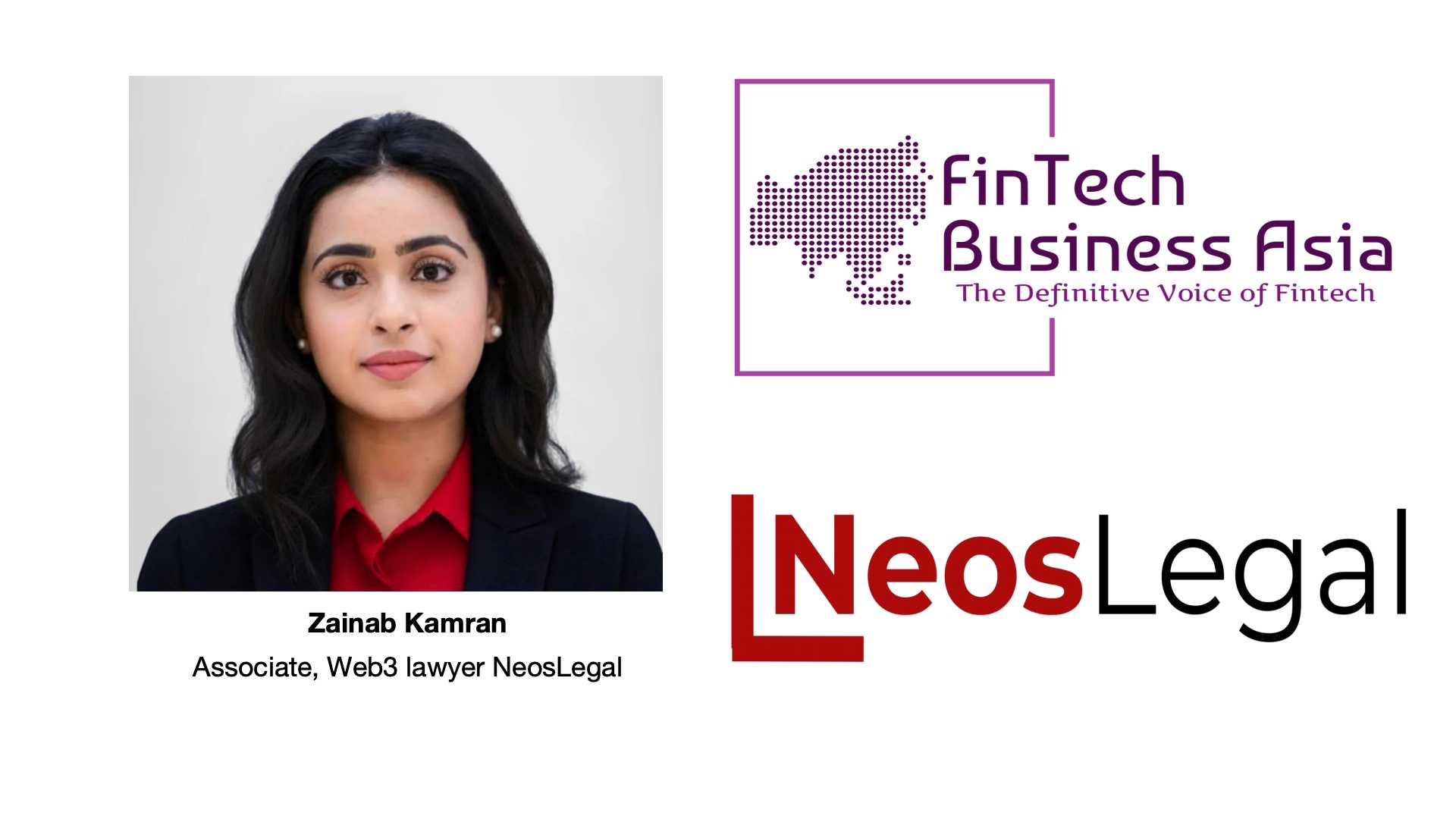
The UAE has emerged as one of the world's most progressive jurisdictions for digital assets, supported by a sophisticated regulatory framework spanning multiple authorities. With the launch of the UAE Crypto License Tracker 2026, investors, founders, and institutions now have a centralized resource to verify licensed virtual asset service providers across the country. In this exclusive conversation with Fintech Business Asia, Zainab Kamran, Associate and Web3 lawyer at NeosLegal, discusses the challenges of building the tracker, the growing importance of regulatory transparency, and how the UAE is positioning itself as a global hub for regulated crypto innovation.
Q: The UAE Crypto License Tracker 2026 consolidates every licensed VASP across five regulatory regimes into a single database. What were the biggest data challenges in aggregating and standardizing licensing information across VARA, ADGM, DIFC, CBUAE, and CMA?
A: The honest starting point is that nothing like this existed before. The information was there, but it was scattered across five separate regulators, each with its own register, its own format, and its own way of publishing (or not publishing) the data. For us as lawyers, that fragmentation is manageable. We know where to look, we know which register sits with VARA versus FSRA versus the DFSA, and we know how to read them. But a normal retail client, a founder, or anyone who doesn't work with these regulators day to day simply doesn't know where to start. And even when they do find the right register, this kind of information isn't easy to pull together in a way that actually tells you the full picture.
So the first challenge was purely one of sourcing and access, bringing five different registers into one place and verifying each entry against the official source. The second, and probably harder, challenge was standardization. The license categories are not consistent across the five regimes. Each regulator defines and names its activities differently. A "broker-dealer" permission under VARA doesn't map cleanly onto how another regulator describes a similar activity, and some regulators bundle activities that others separate out. So a lot of the work was normalizing all of that into a single, consistent set of activities (i.e. Exchange, Custody, Broker-Dealer, Advisory, etc,) so that someone can compare across regulators on a like-for-like basis. That mapping exercise, translating five different taxonomies into one, was where most of the real effort went.
Q: The UAE now operates a multi-regulator digital asset framework rather than a single unified regime. From your perspective, does this regulatory plurality create competitive advantages for the UAE, or does it introduce complexity for market participants?
A: In my view it does both, but for participants who approach it correctly, the advantage clearly outweighs the complexity. Five specialist regulators, each designed for a different type of business, serve the market considerably better than a single authority attempting to govern the entire spectrum of virtual asset activity.
The complexity is real and should not be understated. Operating five parallel regimes means that jurisdiction selection is a foundational legal decision rather than an administrative formality, and an incorrect choice can prove costly and difficult to reverse. The regulatory perimeters overlap in certain areas; a business whose activities span trading, custody, payments and tokenisation may require authorisation from more than one regulator; and without proper guidance, participants risk applying under the wrong regime, or assuming a coverage they do not in fact hold.
That said, this plurality is precisely what gives the UAE its strength, because each regulator has been built for a distinct segment of the market.
The perceived complexity, therefore, is simply the corollary of choice. A founder is able to operate within the framework designed for their particular business model, rather than being forced into a single, ill-fitting regime. The remaining points of friction are also being addressed: the CMA–VARA agreement of August 2025 introduced mutual recognition of licences and joint supervision in order to reduce duplication between the federal and Dubai regimes. The direction of travel is clear: specialisation where it adds value, and harmonisation where overlap creates friction. For market participants, that represents a competitive advantage rather than a burden.
Q: Your tracker highlights that around 100 firms currently hold active VASP licenses in the UAE. What trends are you seeing in terms of the types of firms entering the market—exchanges, custodians, payment providers, or tokenization platforms?
A: The most significant trend is breadth. It is no longer the case that one or two categories dominate; every layer of the virtual asset value chain is now represented in the UAE, and that is precisely what distinguishes this market. The data underlying our tracker bears this out.
Trading infrastructure remains the largest single category. Broker-dealer permissions account for the greatest share of licensed activity, which reflects how global exchanges typically structure their entry into the UAE, establishing trading and brokerage capability first, and building out fuller exchange infrastructure over time.
The clearest emerging trend, however, is institutional custody. Custody has become one of the largest categories in its own right, and the presence of established institutional custodians signals that serious institutional capital is now actively building infrastructure in the UAE rather than merely observing the market. Closely related to this is the growth in asset management and fund activity, which now constitutes the second-largest category overall. This is an indication that the capital-allocation layer of the ecosystem is maturing, not only the trading layer.
We are also seeing the beginnings of a distinct issuance and tokenisation trend. This includes stablecoin and fiat-referenced token issuers, including dirham-denominated payment tokens regulated by the Central Bank, as well as the first wave of tokenisation activity. This category is smaller today, but it is among the fastest developing, and I expect it to become far more prominent as real-world asset tokenisation accelerates.
It is worth emphasising that this activity is not confined to Dubai. Abu Dhabi, through ADGM and the FSRA, accounts for a share of licensed activity almost equal to that of Dubai, and the DIFC is growing steadily alongside them. What the UAE offers, and what few other jurisdictions can, is a complete ecosystem in which every type of participant ranging from exchanges to custodians, asset managers, and payment and stablecoin issuers can be licensed and regulated within a single national market.
Underlying all of this is a broader shift in the industry. The direction of travel is unmistakably towards regulation: increasingly, market participants and their clients regard a licence not as a burden but as the standard, and as the future of the industry. Firms are coming to the UAE precisely because it allows them to operate as regulated entities, and because the full ecosystem exists here to support them. The steady growth in licence numbers year on year, and the continued momentum into 2026, reflects exactly that.
Q: One of the stated goals of the tracker is improving transparency and verification for investors and counterparties. How significant is the issue of “regulatory opacity” in the global crypto industry, and how does this tool address it in practice?
A: It is a very significant issue, and one that is particular to this industry. A large proportion of virtual asset service providers are incorporated offshore, in jurisdictions with limited or no substantive regulation, and because they operate online and across borders, it is often difficult for a user to establish where a platform is actually based, which authority oversees it, and what it is permitted to do.
Compounding this is the loose use of the term "regulated." Firms frequently describe themselves as "licensed" when they hold only a company or anti-money-laundering registration, or a licence in a different jurisdiction or for a different activity than a client assumes. Without accessible verification tools, an investor or counterparty is rarely able to distinguish a full virtual asset licence from a mere registration, or to confirm that a firm's stated status matches what it is genuinely authorised to do. That gap between claimed and actual status is one of the most consequential forms of opacity in the market.
The difficulty is most acute for retail users, who are least equipped to navigate it. Even where official registers exist, they are fragmented across separate authorities, not always easy to locate, and often written in technical language. A layperson is unlikely to know that they must consult VARA, the FSRA, the DFSA, the Central Bank, and the CMA separately, still less how to interpret each one. The people most exposed to risk are therefore those least able to verify what they are dealing with.
This is the problem the tracker was built to address. It consolidates the licensing information from all five UAE regulators into a single, searchable resource, sourced directly from the official public registers and updated monthly. It allows anyone — a retail investor, a counterparty, or a compliance team — to check in seconds whether a firm holds a licence, which regulator issued it, what activities it is permitted to perform, and when it was granted. By setting out the specific scope of each licence, it directly counters the tendency to overstate regulatory status: it shows not merely that a firm is regulated, but precisely what it is regulated to do.
We have also made the tool itself transparent. Because licence categories differ between regulators, we have mapped them to a common set of activities so firms can be compared on a like-for-like basis, and the underlying dataset is published openly on GitHub for independent verification. Equally, we are clear about its limits: it is a first point of reference, not a substitute for the official registers, and we direct users to confirm current status with the relevant regulator before relying on it.
Q: The UAE is increasingly positioning itself as a global hub connecting Europe, Asia, and emerging markets. How do you see the UAE’s licensing framework influencing capital flows and crypto business relocation decisions in the next 2–3 years?
A: I expect the UAE to see a marked and sustained influx of virtual asset businesses over this period, and its licensing framework is central to why.
The most immediate catalyst lies elsewhere, and in MiCA in particular. Now that the European framework is fully in force and its transitional period has ended, only a small fraction of the firms that previously operated under national regimes have secured authorisation; the remainder must either meet a demanding new standard or wind down their European operations. A substantial number of businesses are therefore actively reassessing where they are based, and the UAE is, in my experience, among the most obvious destinations for them.
That is not a matter of chance. The UAE has undertaken a great deal of deliberate work to position itself as a global hub, and that intent is evident in both the regulatory framework and the ecosystem that has developed around it. It has established purpose-built regulators, clear and workable licensing pathways, and a supportive tax and business environment — and, as the tracker demonstrates, an ecosystem in which every category of participant is already present. Firms relocating here are not arriving at an empty market; they are joining an established one, with the banking relationships, service providers, counterparties, and talent that a functioning ecosystem requires.
The UAE's advantage is also geographic. It sits at the point where Asia meets Europe and connects to the wider emerging markets of the Middle East, Africa, and South Asia. For a business whose users and capital are global, that connectivity, of time zone, of access, and of capital flows is a genuine structural advantage, and one that is difficult to replicate elsewhere.
I would add one important qualification. This is not a movement towards a lighter-touch jurisdiction; the UAE's own requirements are demanding, and the firms choosing it are, for the most part, choosing to be properly regulated rather than to avoid regulation. That, in my view, is the real significance of the trend. As the industry matures, holding a licence is increasingly the standard that capital and counterparties expect, and the UAE offers a credible and comprehensive framework through which to meet it. Over the next two to three years, I expect that combination of regulatory credibility, a complete ecosystem, and a connecting geography to continue drawing both capital and businesses, and to deepen the UAE's standing as one of the principal centres of the global virtual asset industry.
Q: Looking ahead, could this tracker evolve into a broader regulatory intelligence platform covering licensing changes, compliance updates, and enforcement actions—and potentially be replicated in other jurisdictions across Asia and the Middle East?
A: There is both a clear need and real potential for it to develop in that direction. The tracker in its current form answers a specific question: who holds a licence, and for what? But the same opacity that makes that question difficult also applies to what happens next. Knowing that a firm is licensed today is valuable; knowing when its status changes, when the rules governing it are updated, or when a regulator takes enforcement action is arguably just as important, and that information is at present even more scattered and harder to follow.
Extending the tool to capture those dimensions, licensing changes over time, regulatory and compliance developments, and enforcement activity, is therefore a natural next step, and we have deliberately built it on a foundation that can support that growth. The dataset is openly published and structured, and updated on a regular basis, precisely so that it can be expanded as the need arises.
The underlying model is also not specific to the UAE. The fragmentation we set out to address exists across much of Asia and the wider Middle East, where market participants face the same difficulty of piecing together licensing information from multiple authorities. The methodology could, in principle, be applied to those markets as well.
For now, our focus is the UAE, and as that market continues to grow there is ample room to deepen and broaden our coverage here first. How far the tool evolves beyond that will be guided by need and by demand. But the direction of travel, and the appetite for this kind of transparency, are both clear.






Fintech Business Asia, a business of FinTech Business Review
© 2026 FinTech Business Review. All Rights Reserved.