
05 August 2026 | Wednesday | Interaction
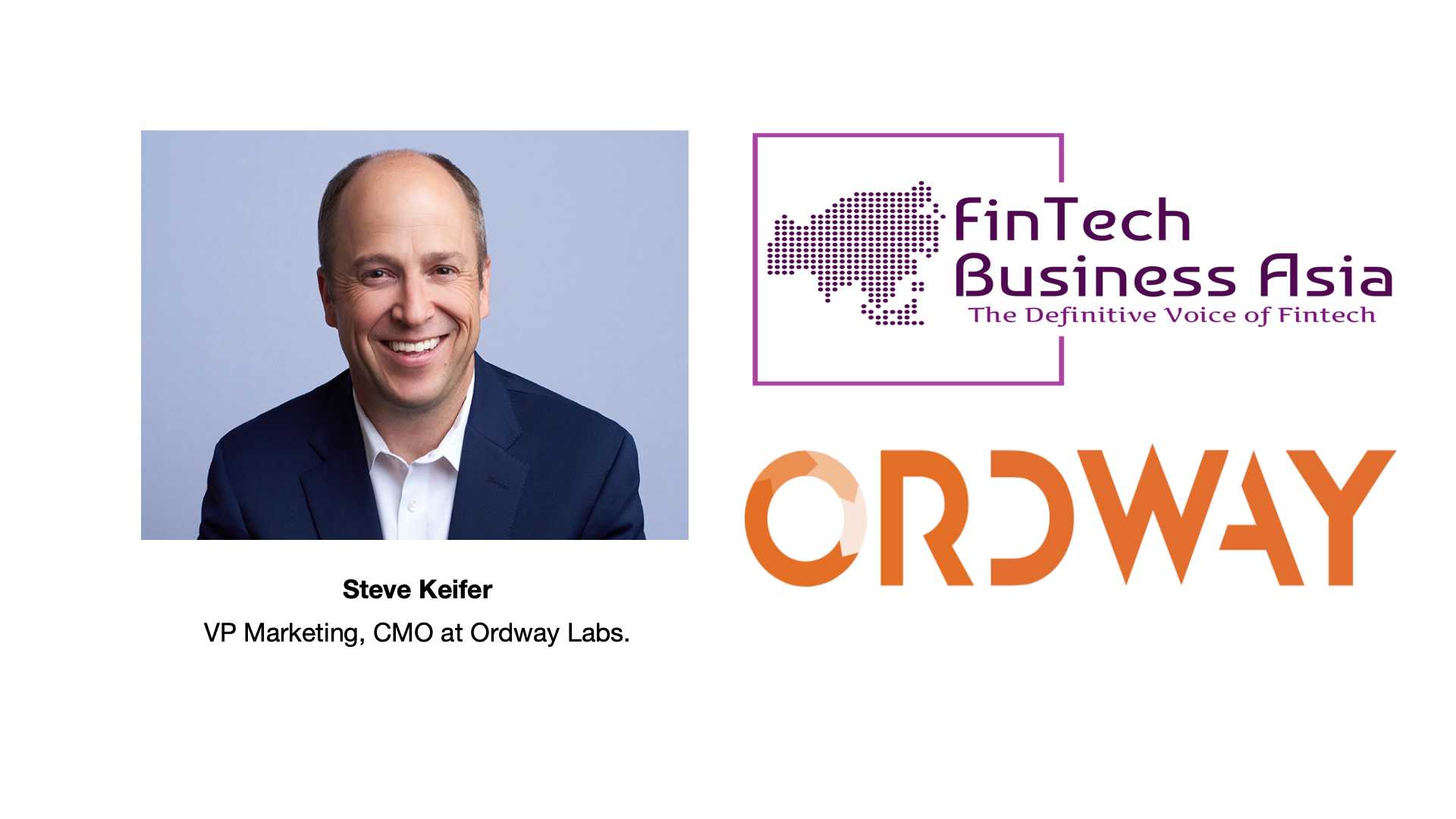
As finance teams grapple with rising payment volumes, fragmented billing systems, and increasingly complex subscription-based business models, reconciliation has become one of the biggest operational pain points. Ordway Labs aims to change that with Ordway Payments, a unified platform that combines billing, payment processing, and AI-powered cash application into a single system. In this interview with Fintech Business Asia, Steve Keifer, VP Marketing and CMO at Ordway Labs, discusses how AI is transforming invoice-to-cash workflows, the safeguards required for enterprise adoption, opportunities across Asia-Pacific, and the company's long-term vision for autonomous finance.
Q: Ordway Payments brings billing, payment processing, and AI-powered cash applications into a single platform. What inspired the development of this solution, and how does it address the long-standing reconciliation challenges faced by modern finance teams?
A: This came straight from our customers. For years we watched finance teams do great work on the front end- timely invoices and multiple customer-friendly payment channels and then lose days every month at the back end matching receipts to invoices by hand. The billing system said one thing, the payment processor said another, and the bank statement said something else. Somebody had to reconcile all of it in a spreadsheet.
That gap between billing and payments is where the pain lives. A customer sends one wire to cover five invoices. A check arrives with no invoice number on it. A refund gets issued in one system and never makes it back to the other. At month-end there are hundreds of these tiny puzzles. Controllers kept calling it the reconciliation mess, so we built Ordway Payments to make it disappear.
The idea was simple. We stopped treating payments as a separate tool bolted on at the end and brought card and ACH processing, refunds, disputes, and AI-powered cash application into the same platform that already runs billing and revenue recognition. Because it is one system with one data model, an incoming payment can be matched to the right invoice and posted to the customer balance automatically. No re-keying, no toggling between consoles, no reconciliation tax.
Q: Your AI-driven cash application engine can automatically match payments from multiple sources, including wire transfers, checks, and lump-sum payments covering multiple invoices. How does the AI handle complex real-world payment scenarios while maintaining high accuracy and customer trust?
A: We built the engine around how messy real payments actually are. It uses two kinds of matching together. Deterministic logic handles the clean cases where the amount, customer name, and invoice or PO number all line up. Probabilistic logic handles the fuzzy cases, scoring the most likely match when the descriptor is vague or the numbers do not add up neatly. The models are trained on billions of historical transactions, so they have seen the odd cases before, whether that is one payment covering several invoices, one invoice split across two payments, a partial payment, or an overpayment.
Trust is where we are deliberately conservative. Every match gets a confidence score. High-confidence matches are applied automatically, and anything lower is routed to a person on the accounting team to review. The AI does the heavy lifting on the thousands of obvious matches, and people spend their time only on the real judgment calls. The system also learns from every correction, so accuracy improves over time and the finance team stays in control. We are not asking anyone to trust a black box.
Q: Many businesses are moving toward subscription, usage-based, and hybrid pricing models. How does Ordway Payments help finance teams streamline the entire invoice-to-cash lifecycle while supporting these increasingly complex revenue models?
A: This is our home turf. Ordway was built for companies whose pricing does not fit in a neat box: subscriptions, usage-based, transaction-based, and every hybrid model in between. The billing engine handles tiered and volume pricing, metered usage, overages, rollovers, prepaid credits, minimums, and mid-cycle proration. That flexibility is the foundation everything else sits on.
Complex pricing actually makes reconciliation harder, because invoices vary every month when usage varies. Since Ordway runs billing, accounts receivable, and revenue recognition on one platform, an invoice flows straight through to collection, cash application, and the journal entry with nobody stitching the pieces together. The deal is priced, the invoice is generated, the customer pays through whatever channel they prefer, the AI matches the payment, and that match triggers the revenue recognition entries automatically. Finance teams get a clean path from quote to cash instead of a relay race between four disconnected tools.
Q: As finance organizations embrace AI, concerns around explainability, compliance, and data security remain top priorities. What safeguards has Ordway built into its AI-powered reconciliation engine to ensure transparency, auditability, and regulatory compliance?
A: We take this seriously because we are working with our customers' financial records. The first safeguard is the human-in-the-loop design. The AI does not get the final word on ambiguous matches; anything below the confidence threshold goes to a person, so a human always owns the judgment calls.
The second is auditability. Because cash application is wired directly into revenue recognition, every matched payment produces the matching journal entries in the subledger. That gives you a clean, traceable trail from payment to invoice to accounting entry, and it supports ASC 606 and IFRS 15 across multiple entities, currencies, and jurisdictions.
On security, Ordway has completed a SOC 2 audit against the AICPA criteria for security, availability, and processing integrity, and that report is available on request. We are also clear in our customer agreement that customers should review AI outputs before relying on them and that AI output is not a substitute for accounting, tax, or legal advice. In finance, explainability and control are the price of entry, so we designed the guardrails first.
Q: Asia-Pacific is witnessing rapid growth in digital payments and finance automation. How do you see demand for AI-powered reconciliation evolving across the region, and are there plans to expand partnerships or tailor Ordway Payments for enterprises in Asian markets?
A: Asia-Pacific is one of the most exciting payments markets in the world right now. The region's digital payments market is growing at well over 20 percent a year, with India among the fastest-moving markets anywhere. When volume grows that fast across so many channels, the reconciliation problem does not shrink, it explodes. That is exactly the environment where manual matching breaks and AI-powered cash application earns its keep, so we expect demand for this kind of automation to rise sharply.
A lot of what enterprises in Asia need is already in the platform. Ordway supports multi-currency billing, computes GST and VAT across jurisdictions, handles international wire transfers, and works across multiple entities and ledgers. Our cash application engine already ingests payments from cards, digital wallets, bank transfers, wires, and checks. Rather than promise a fixed rollout date, our approach is to keep expanding channel coverage, payment partnerships, and localization in step with customer demand, and the signal from this region is getting louder.
Q: Looking ahead, what is Ordway's long-term vision for autonomous finance operations?
A: Our long-term vision is a finance function that mostly runs itself, with people focused on judgment instead of data entry. For decades, accounting teams have spent the best part of every month on repetitive manual work. We think AI can finally put an end to that, so closing the books is no longer a monthly fire drill.
We get there one agent at a time, each solving a real chore. We have already shipped an AI cash application agent, a natural-language assistant for asking about ARR, retention, and churn in plain English, and a contract abstraction agent that pulls billing terms straight out of contracts. Stitch these together and you see what autonomous finance looks like: invoices generate themselves, payments match themselves, entries post themselves, and the metrics are ready the moment someone asks. The human role shifts from doing the work to supervising it and making the strategic calls.
Q: Can customers expect additional AI capabilities in areas such as accounts receivable automation, predictive cash flow management, or intelligent payment orchestration over the next 12 to 24 months?
A: Yes. Everything we have released so far follows one pattern: find a painful, repetitive finance task and hand it to an AI agent that does it faster and more accurately. That points clearly toward more of the receivables and cash cycle becoming intelligent.
On accounts receivable, we already automate dunning, retries, aging, and DSO tracking, so making those workflows smarter is a natural next step. On cash flow, we already pull billing, collections, and contract data into one place, which is the foundation for more predictive insight. On payment orchestration, the platform already routes payments across many gateways, which is the groundwork for smarter routing. Without putting a hard date on any single feature, customers should expect our AI footprint across receivables, cash flow, and payments to keep expanding. The goal is consistent: less manual reconciliation, faster close, and finance teams spending their days on strategy instead of spreadsheets.






Fintech Business Asia, a business of FinTech Business Review
© 2026 FinTech Business Review. All Rights Reserved.